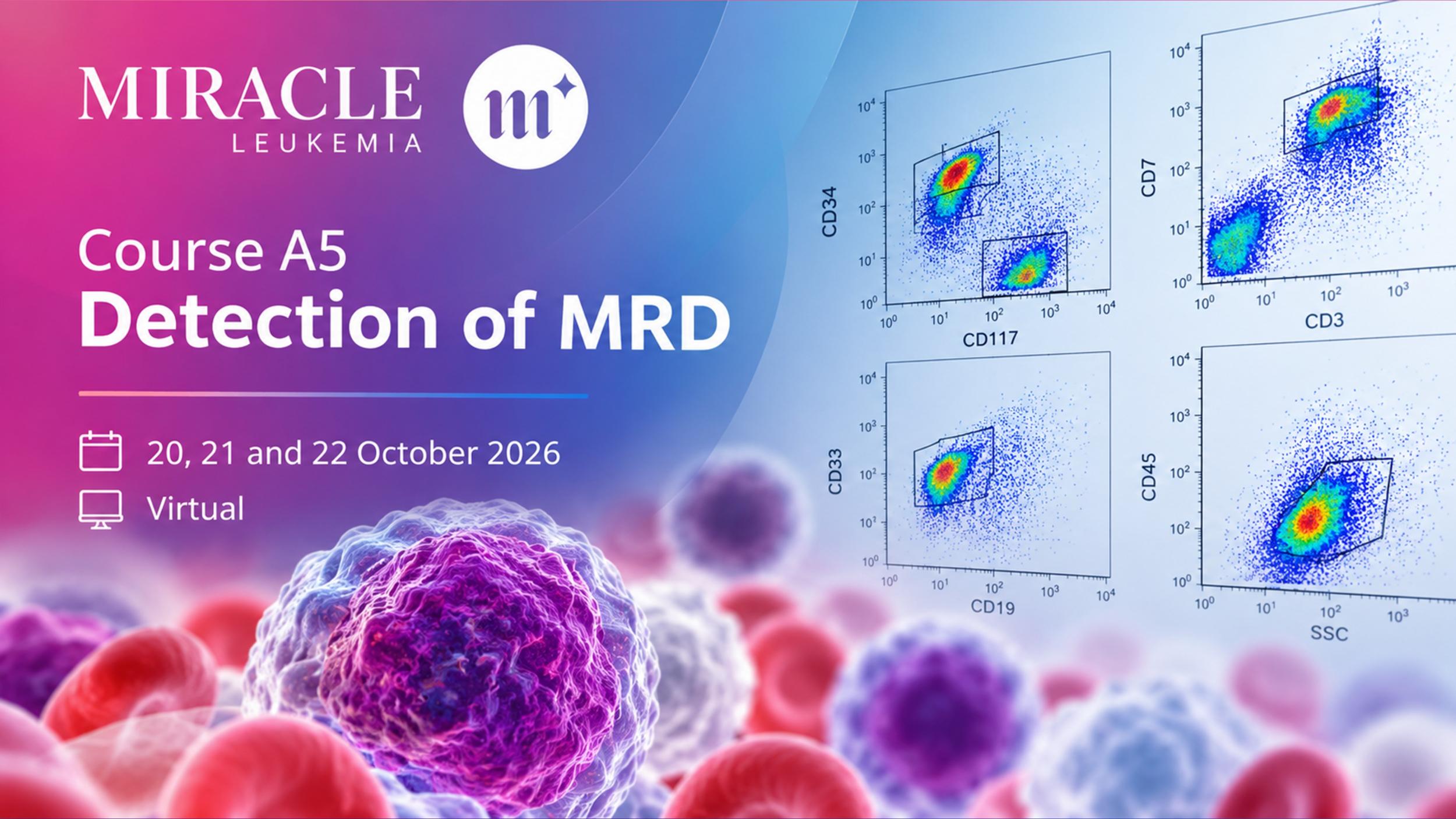
MIRACLE Course A5: Detection of MRD
From 20–22 October 2026, MIRACLE Doctoral Candidates participated in Course A5: Detection of MRD, a three-day virtual training course organized as part of the XIII Virtual Prague School on Flow Cytometry 2026, under the auspices of the European Society for Clinical Cell Analyses (ESCCA). The course was led by Prof. Jacqueline Cloos (Amsterdam UMC) and organized in collaboration with Dr. Iuri Marinov (Institute of Hematology and Blood Transfusion, Prague). It focused on the detection of measurable residual disease (MRD) and leukemic stem cells (LSCs) using flow cytometry, a key methodology for identifying and characterizing residual leukemic cells following treatment.
From MRD Detection to Advanced Data Analysis
The programme combined scientific lectures with practical approaches to MRD detection and analysis, covering staining panels, gating strategies, recent advances in standardization, and innovative approaches to automated flow cytometry data analysis. Particular attention was given to MRD assessment in acute myeloid leukemia (AML), including the latest European LeukemiaNet (ELN) recommendations, practical applications of flow cytometry, and strategies for detecting leukemic stem cells within MRD populations. Dedicated sessions also explored MRD detection in acute lymphoblastic leukemia (ALL), including both B-cell precursor ALL and T-cell ALL, providing participants with insights into different disease-specific approaches.
The programme brought together expertise from several European institutions, offering MIRACLE Doctoral Candidates the opportunity to learn from specialists in clinical flow cytometry and MRD research. By combining MIRACLE-specific sessions with the broader Prague School programme, participants were exposed to both established methodologies and emerging developments in the field.
View the Course A5 programme here >>
Strengthening Research Skills Across the MIRACLE Network
The course contributed directly to MIRACLE’s scientific and training objectives by strengthening the Doctoral Candidates’ methodological expertise in MRD detection, characterization, and interpretation. These competencies are particularly relevant to the network’s interconnected research projects, which investigate the biological mechanisms underlying MRD and explore new approaches to its detection and eradication. As part of MIRACLE’s multidisciplinary doctoral training programme, Course A5 illustrates how specialized scientific training and international knowledge exchange support the development of the next generation of leukemia researchers.
“Measurable residual disease is increasingly important in understanding treatment response and guiding clinical decisions in leukemia. Advances in detection technologies, standardization and data analysis are creating new opportunities, but important scientific challenges remain. Through MIRACLE, we want to equip our Doctoral Candidates with the knowledge and critical understanding to address these challenges and contribute to the next generation of MRD research, ultimately helping us move towards more personalized and effective leukemia treatment.”
— Prof. Jacqueline Cloos, Amsterdam UMC, MIRACLE Project Coordinator and Course A5 Lead
Acknowledging our speakers and contributors
A special thank you to lecturers speakers who contributed their expertise to this training programme: Prof. Jacqueline Cloos, Willemijn Scholten BsC, Tom Reuvekamp and Dr. Costa Bachas of Amsterdam UMC. Their contributions provided MIRACLE Doctoral Candidates with valuable insights into current methodologies, practical challenges, and recent advances in MRD detection and analysis. We also extend our appreciation to Dr. Iuri Marinov of the Institute of Hematology and Blood Transfusion, organizer of the XIII Virtual Prague School on Flow Cytometry 2026.